
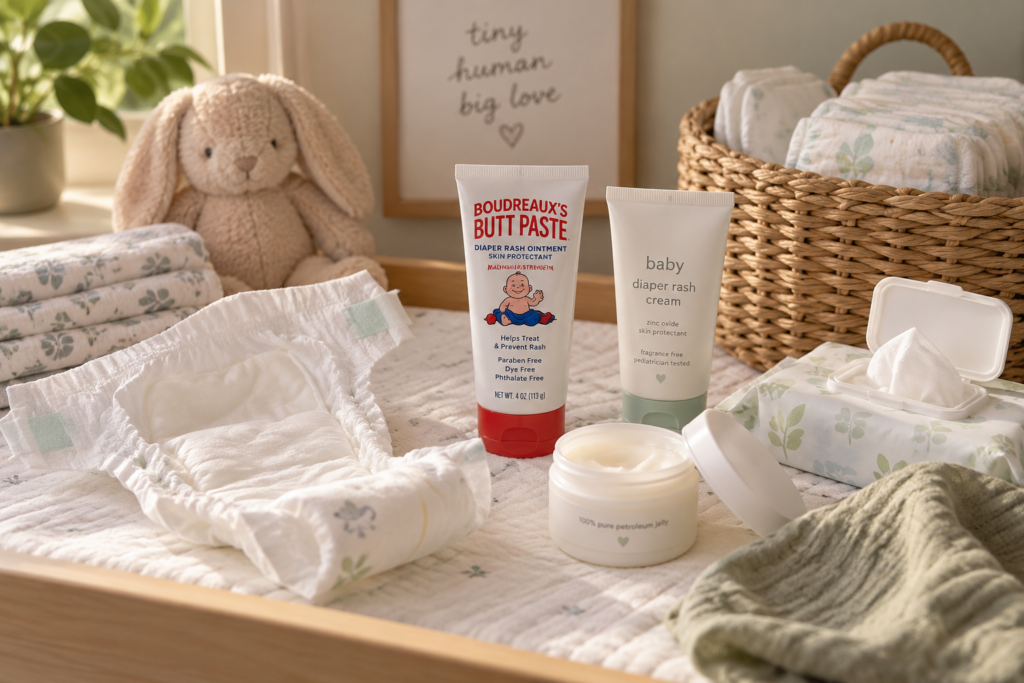
Before I had a baby, I used to think diaper rash cream was kind of funny.
I’d go to baby showers and sometimes bring a tube of Boudreaux’s Butt Paste as part of the gift. Mostly because of the name. It always got a laugh.
Then I had a baby.
Suddenly, diaper rash wasn’t quite so funny.
My daughter had sensitive skin and was prone to eczema, including on her face and arms. So when it came to anything I put on her skin, I worried about what was in it. And when it came to diaper cream, I didn’t want to grab just anything off the shelf.
I remember researching creams that were supposed to be better for babies with sensitive skin. I tried several. Some I could only find at places like Whole Foods, and of course they were more expensive.
Were they actually better?
Honestly, I don’t know.
What I do remember is trying to prevent diaper rash in the first place. I changed her diaper frequently because I didn’t want moisture sitting against her skin for too long. I paid attention to the products we used because her skin was already sensitive. And, like a lot of new parents, I probably spent more time reading ingredient labels than I ever imagined I would.
She’s 14 now, and I can’t tell you which diaper cream ultimately “won.” I don’t even remember all the ones we tried.
But that actually made me curious.
If I were standing in the diaper aisle today, what would I need to know? Does a more expensive diaper cream actually work better? Does a baby with eczema need something different? Is preventing diaper rash mostly about the cream—or is it really about what’s happening underneath the diaper?
So I went back and looked at what pediatricians, dermatologists and newer research say now.
And some of it is reassuringly simple.
Because here’s the thing about being a new parent: if you can afford to buy what you think is the best product for your baby, you probably will.
I know I did.
Diapers are already expensive. Then add wipes, creams, lotions, special washes and all the other things marketed to parents of babies with sensitive skin. When you’re standing in the aisle comparing a $6 tube of diaper cream with a $16 one that promises to be extra gentle, it’s easy to wonder whether spending more is what a good parent is supposed to do.
But when I went back and looked at the guidance today, one of the things that struck me was how basic some of the advice still is.
Change wet or soiled diapers frequently. Clean the skin gently. Give it a chance to dry. Protect it with a good barrier cream or ointment when needed. Pay attention to ingredients that may irritate your baby’s skin.
That’s not to say every diaper cream is identical, or that ingredients don’t matter—especially for babies with sensitive skin.
But the most expensive option isn’t automatically the best one.
And sometimes that’s exactly the kind of thing a new parent needs to hear.
First, diaper rash is really common
If your baby develops diaper rash, it doesn’t mean you’ve done something wrong.
According to the American Academy of Pediatrics (AAP), at least half of babies develop diaper rash at some point.
The most common kind is irritant diaper rash, or irritant dermatitis. Think about the environment inside a diaper: warmth, moisture, rubbing, urine and stool all spending time against very delicate skin.
Leave that combination together long enough and irritation can happen.
Diarrhea can make things worse because it increases the amount of stool contacting the skin. A diaper that’s too tight can create more friction and trap moisture. And sometimes a baby’s skin simply reacts to a product being used in the diaper area.
So yes, diaper cream can matter.
But preventing and treating diaper rash starts with something even simpler: what’s happening between the baby’s skin and the diaper.
Turns out, changing diapers frequently really does matter
At least I got this part right.
I remember being pretty diligent about changing my daughter’s diaper because I didn’t want her sitting in a wet diaper.
Current pediatric and dermatology guidance still recommends exactly that.
Changing wet or soiled diapers promptly reduces the amount of time the skin spends in contact with moisture, urine and stool. The AAP also notes that stool contains digestive enzymes that can irritate the skin.
That doesn’t mean you need to panic because you didn’t notice a wet diaper immediately.
It means that, as much as reasonably possible, keeping the diaper area clean and dry is one of the simplest ways to protect the skin.
The American Academy of Dermatology goes so far as to call frequent diaper changing its most important tip for preventing and treating diaper rash.
Sometimes the boring advice really is the good advice.
So what actually matters in a diaper cream?
This is the part I wish I’d understood when I was searching for specialty creams.
According to the AAP, when it comes to barrier creams and pastes, the brand is less important than the ingredients.
Two of the tried-and-true ingredients are:
Zinc oxide. This is the thick white ingredient you’ll find in many diaper pastes. It forms a physical barrier between irritated skin and moisture, urine and stool.
Petrolatum. Yes, basically petroleum jelly. It also creates a protective barrier over the skin.
And fragrance-free is generally preferable, particularly when skin is already irritated or sensitive.
That’s remarkably straightforward.
It also means the product in the prettier package, the one sold at the specialty store or the one with the higher price tag isn’t automatically going to protect your baby’s skin better.
For parents watching every dollar—and diapers alone can add up quickly—that’s useful to know.
And apparently, I wasn’t using enough
Here’s another thing I might have gotten wrong.
I don’t remember how much diaper cream I used, but knowing myself, I probably applied a nice, neat little layer.
Current guidance is not particularly interested in neat.
The AAP recommends a thick layer of barrier paste. The idea is to create an actual shield between the baby’s skin and what’s inside the diaper.
And if the barrier cream from the last diaper change is still clean?
You don’t necessarily need to scrub it all off.
Removing it aggressively can further irritate already-sensitive skin. The AAP recommends leaving clean paste in place and adding more over it.
So apparently the diaper cream approach is less delicate skincare application and more frosting a cupcake.
That probably would have saved me some time.
What if your baby has sensitive skin or eczema?
This was the part that made me especially cautious.
My daughter was prone to eczema, so I already knew her skin could react to things.
Eczema and diaper rash aren’t the same condition. But babies with sensitive skin or atopic dermatitis can be more prone to irritation, and products used in the diaper area can sometimes cause reactions of their own.
The AAP notes that occasionally babies with sensitive skin can react to ingredients in diapers, wipes or creams—including dyes, fragrances and preservatives.
For children with eczema, pediatric and dermatology guidance also generally recommends gentle, fragrance-free skin-care products.
Looking back, that makes me feel a little better about all the label reading I was doing.
Maybe I didn’t need every expensive specialty product I bought.
But paying attention to what was going onto her already-sensitive skin wasn’t unreasonable either.
What about wipes?
Here’s another place where simple may be better.
For routine diaper changes, gentle cleaning is the goal—not scrubbing the skin until it feels squeaky clean.
The AAP recommends alcohol- and fragrance-free wipes, or water with a gentle non-soap cleanser. When a rash is particularly irritated or there are open sores, even wiping can hurt. Rinsing with water from a squirt or spray bottle can be gentler.
Then pat the skin dry or let it air-dry rather than rubbing it.
And yes, letting your baby hang out without a diaper for a little while can actually help.
Fresh air is free.
Finally, a baby product that doesn’t cost anything.
Is “natural” automatically better?
This is where I’d be more skeptical today than I probably was in 2012.
“Natural,” “clean,” “premium” and similar language can sound reassuring when you’re buying something for a baby.
But those words don’t automatically tell you whether a product will work better for diaper rash—or whether your baby’s particular skin will tolerate it.
Even plant-based or botanical ingredients can irritate some sensitive skin.
For diaper rash, the more useful questions may be much less glamorous:
Is it fragrance-free?
Does it contain a proven barrier ingredient such as zinc oxide or petrolatum?
Does my baby’s skin tolerate it?
And is it actually helping?
That’s a lot easier than standing in Whole Foods trying to decipher 14 ingredient labels.
Sometimes it isn’t just a regular diaper rash
This is an important one.
Not every rash in the diaper area is the same.
The most common type is irritant dermatitis, but babies can also develop yeast infections, bacterial infections or allergic reactions. Other skin conditions can sometimes look like diaper rash too.
One clue pediatricians look at is where the rash appears.
A typical irritant diaper rash often affects the skin that has the most contact with the diaper while sparing the deeper folds of the groin.
A yeast rash can look different. The AAP describes it as often being bright red or pink, with sharper edges and sometimes smaller bumps or pimples around it. Unlike ordinary irritant diaper rash, yeast can be particularly noticeable in the skin folds.
That’s not something parents need to diagnose on their own.
It’s something to know because if you’re faithfully applying barrier cream and the rash keeps getting worse, the answer may not be “more diaper cream.”
Your pediatrician may need to take a look.
When should you call the pediatrician?
Most mild diaper rashes can be managed at home.
But the AAP recommends contacting your child’s doctor if the rash isn’t improving or is getting worse after about two to three days of treatment.
You should also call your pediatrician if you see things like:
- Blisters, pimples, peeling skin, pus, oozing or crusted sores
- A rash that appears especially painful
- A fever along with the rash
- A bright red rash with spots around the edges, particularly if your baby has recently taken antibiotics
- A rash that simply isn’t clearing despite keeping the area clean, dry and protected
A pediatrician can determine whether you’re dealing with ordinary irritation, yeast, a bacterial infection, an allergic reaction or something else—and recommend the appropriate treatment.
That matters because those conditions aren’t all treated the same way.
In other words, don’t keep buying progressively more expensive diaper creams hoping one of them will magically fix a rash that may need a completely different treatment.
A simple diaper-rash routine
If I were doing this again today, I’d start here:
Change frequently. Don’t let wet or soiled diapers sit against the skin longer than necessary.
Clean gently. Use water or alcohol- and fragrance-free wipes and avoid aggressive rubbing.
Let the skin dry. Pat rather than scrub, and give your baby some diaper-free time when practical.
Use a barrier. Zinc oxide or petrolatum are well-established options. For an active rash, apply a good protective layer rather than a tiny dab.
Skip unnecessary fragrance. Especially if your baby already has sensitive or eczema-prone skin.
Check the fit. A too-tight diaper can trap moisture and create friction.
Pay attention to what’s changing. If a rash appeared after switching wipes, diapers, creams or laundry products, consider whether something new could be irritating the skin.
Know when it’s time to call. A persistent, worsening, painful or unusual-looking rash deserves a conversation with your pediatrician.
What I’d tell my new-mom self now
I don’t regret being careful about what I put on my daughter’s skin.
She had eczema. Her skin was sensitive. I was her mom, and I wanted to protect her.
Of course I did.
But I might tell that version of myself standing in Whole Foods comparing expensive tubes of diaper cream that she could relax a little.
Read the ingredients.
Keep her clean and dry.
Change her diaper frequently.
Be gentle with her skin.
Use a good barrier when she needs one.
And if something doesn’t look right or isn’t getting better, call the pediatrician.
You don’t necessarily need the fanciest product on the shelf.
You need the one that works for your baby’s skin.
And maybe a tube of Boudreaux’s Butt Paste isn’t such a funny baby shower gift after all.
Sources & further reading
- American Academy of Pediatrics / HealthyChildren.org — Common diaper rashes & treatments
- American Academy of Pediatrics / HealthyChildren.org — How to treat and control eczema rashes in children
- American Academy of Dermatology — How to treat diaper rash
- Mayo Clinic — Diaper rash: Symptoms & causes
- Mayo Clinic — Diaper rash: Diagnosis & treatment
- PubMed — Recent systematic review of diaper dermatitis prevention and management
This article is for general educational purposes and isn’t a substitute for medical care. If you’re concerned about your baby’s rash, contact your child’s pediatrician.
We’d love to hear from you!
What stood out to you from this post? Your stories, questions, and ideas help make this community stronger.