
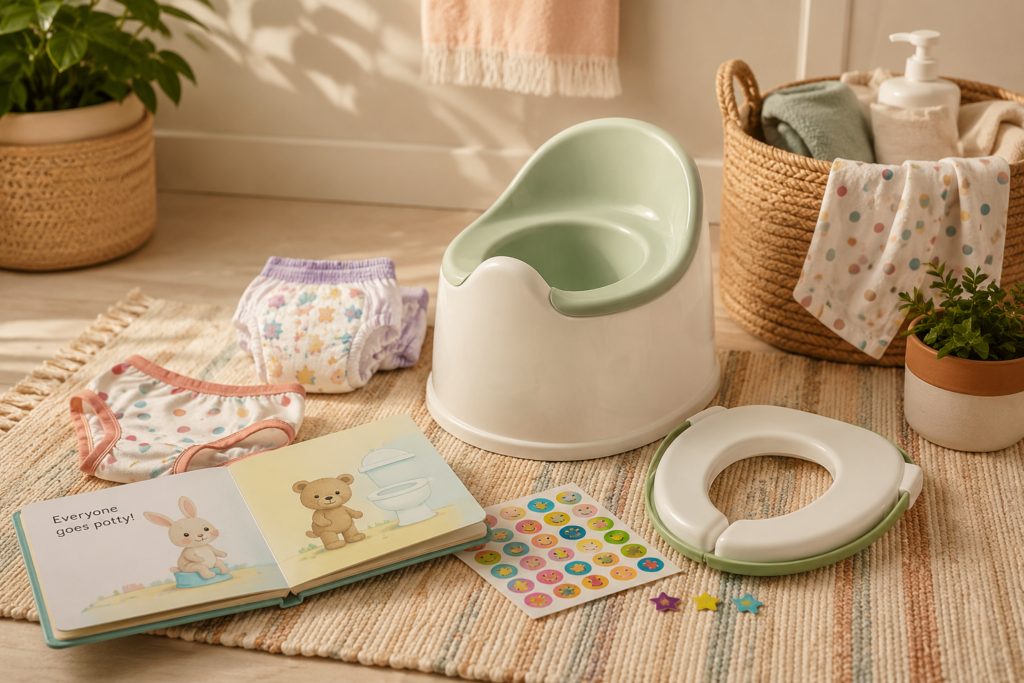
When I first started potty training my daughter, she was around 2 years old.
What an experience that was.
There were books about the potty. Songs about the potty. Books to read while sitting on the potty. Rewards. A small toy. A piece of her favorite candy.
Looking back, it seems like a blur, but I do remember it being as difficult as it was amusing.
First, we read her books about the potty. Then came the transition from diapers to “big girl pants.”
The first time I showed her the little potty we bought for her, she covered her face with her hands, shook her head no, and ran out of the bathroom.
Well, okay then.
Eventually, she went number 1 in the potty, and pretty soon she was comfortable doing that.
Number 2 was another story.
She absolutely refused to poop in the potty.
When she had to go, she would run to the drawer where we kept the Pull-Ups, put one on, hide behind her bedroom closet door, and poop in private.
Apparently, she had a system.
The day she finally pooped in the potty, we cheered. I may have even posted about it on Facebook. This was before we all thought quite as carefully about what our children might someday think about the things we posted about them online.
Sorry, honey.
As much as we trained at home, though, I think the real breakthrough happened at preschool, where Miss Monique, aka Momo, lined up the kids and took them to the potty like clockwork.
Thank God for Miss Momo!
And then there was potty training on the go.
Big toilets away from home can be scary when you’re little. So when we were out and about, we carried a child-size toilet seat that fit over a regular toilet. Because what were we supposed to do, carry her whole potty around with us?
The portable seat was still a little cumbersome, but considerably less cumbersome than traveling around town with a toddler potty. It made those giant public toilets feel a little more manageable and gave her a smaller seat that she could comfortably sit on without feeling like she might fall in.
Just one more piece of equipment to add to all the other stuff you somehow end up carrying when you have a small child.
But the potty-training battles weren’t quite over yet.
My husband and I were worried about nighttime accidents, so we bought pads for the bed. And every morning before school in kindergarten, and even first grade, I begged my daughter to go potty before we left.
Sometimes she couldn’t.
I’d drop her off at her classroom terrified that this would be the day she had an accident.
She never did.
I swear to this day, she has a bladder of steel.
She’s 14 now, so this was a long time ago. I honestly don’t remember exactly which Pull-Ups or nighttime training pants we used, or when we switched from one thing to another. I’m pretty sure we used something more absorbent at night, along with a bed pad.
What I do remember is wondering whether we were doing any of this right.
And apparently, parents are still wondering the same thing.
So, Pull-Ups? Training pants? Regular underwear? Nighttime underwear? Rewards? No rewards? Wait until they’re ready? Start early?
Here’s what I wish I’d understood then.
Potty training isn’t really one milestone
We tend to talk about children as either “potty trained” or “not potty trained.”
But that’s not really how it works.
Learning to recognize the need to pee, making it to the toilet, managing clothing, pooping in the toilet, staying dry while away from home and staying dry overnight are all different skills. A child may master one long before another.
That certainly describes my daughter.
Peeing in the potty? Got it.
Pooping in the potty? Absolutely not.
Sleeping without an accident? Eventually.
Going an entire school day without using the bathroom while her mother quietly panicked? Apparently no problem whatsoever.
Current pediatric guidance generally focuses less on reaching a particular age and more on signs that a child is ready to begin learning. Those can include recognizing when they need to go, communicating that need, walking to and sitting on a potty, pulling clothing up and down, and staying dry for longer stretches.
Many children begin showing those skills somewhere around the toddler years, but there isn’t one magic birthday when every child should suddenly be ready.
Pull-Ups, training pants or underwear?
This is where things can get confusing, because “training pants” can mean several different things.
There are regular underwear, thicker reusable cloth training pants, disposable pull-on training pants, nighttime training underwear and various products designed specifically for heavier overnight wetting.
They’re not necessarily interchangeable.
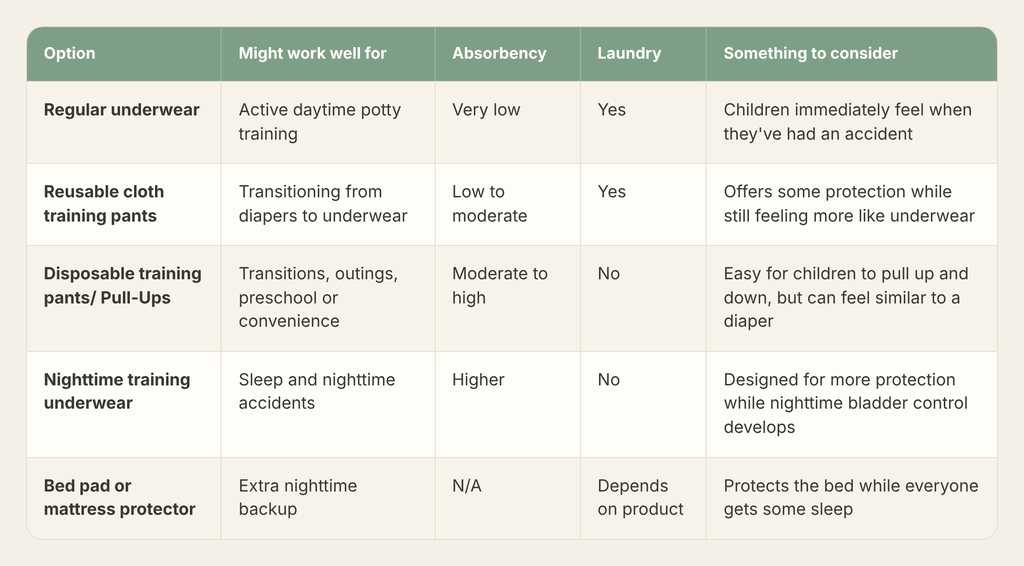
Absorbency and features vary considerably by product and brand.
One thing I didn’t fully appreciate when we were going through this is that Pull-Ups aren’t necessarily a required stage between diapers and underwear.
Some pediatric guidance encourages moving to underwear or cloth training pants during active daytime training because disposable training pants can feel a lot like diapers. The thinking is that feeling wet can help a child connect the sensation of having an accident with the need to use the toilet.
Other guidance takes a more flexible approach and recognizes that disposable training pants can be useful during the transition, particularly for outings, travel, preschool, naps or situations where accidents are harder to manage.
Which brings us to the answer parents probably don’t want:
It depends.
Your child’s readiness matters. Your childcare situation matters. Your tolerance for cleaning pee off the floor matters.
And what works one week may not be what works a month later.
Pee? Fine. Poop? Absolutely not.
I had no idea when my daughter was hiding behind her closet door in a Pull-Up that this was something other children did too.
Turns out, it is.
Some children become comfortable urinating in the toilet but refuse to have a bowel movement there. They may ask for a diaper or Pull-Up, go somewhere private, hide, or wait until they’re back in a familiar environment.
There can be a lot going on.
Pooping requires a child to recognize different body signals, relax certain muscles and feel secure enough to let go. Fear of the toilet, previous painful bowel movements, constipation, changes in routine and simple resistance can all play a role.
I actually remember taking my daughter to the pediatrician at one point because she hadn’t pooped in a while. If I remember correctly, they recommended MiraLAX or something similar to help with the constipation.
At the time, I don’t know that I connected all of these things. I just knew she wouldn’t poop in the potty and then, at one point, she wasn’t pooping enough at all.
Looking back, it makes more sense why pediatric guidance warns parents to pay attention to stool withholding and constipation during potty training. A painful bowel movement can make a child afraid to poop, which can lead them to hold it even longer and potentially make the problem worse.
And turning it into a battle can make things worse too.
If your child is withholding stool, having painful bowel movements, going an unusually long time without pooping or becoming constipated, talk with their pediatrician. Don’t give a child a laxative or stool softener based on what worked for someone else’s child. Their doctor can tell you what’s appropriate for them.
In our case, our daughter eventually got there.
And yes, we celebrated poop.
Parenthood changes you.
Thank God for Miss Momo
I give preschool a lot of credit for helping my daughter finally get comfortable with the potty.
At home, potty training felt like this major project we were managing.
At preschool?
Miss Momo lined those kids up and took them to the bathroom.
Every. Single. Day.
There was a routine. Everyone was doing it. Nobody was negotiating.
Apparently, Momo knew what she was doing.
Routine is actually an important part of potty training. Regular opportunities to use the bathroom, particularly after waking, after meals, before leaving the house and before bed, can help children learn to recognize their body’s patterns.
There’s also something to be said for seeing other kids do it.
Sometimes a parent can explain something 47 times and then a teacher, coach or preschool friend does it once and suddenly your child gets it.
If you’ve been a parent for more than five minutes, you probably already know this.
And then you have to leave the house
Potty training at home is one thing.
Potty training when you’re standing in a public restroom with a toddler staring suspiciously at an enormous toilet is another.
Big toilets away from home can be scary when you’re little.
We carried a portable child toilet seat that fit over a standard toilet. It gave my daughter a smaller, more secure place to sit without requiring us to drag her entire potty everywhere we went.
Was it still a little cumbersome?
Yes.
Was it better than carrying an entire potty around?
Also yes.
So that became another thing we carried around with us.
Potty seat. Extra underwear. Extra clothes. Wipes.
Add them to the seemingly endless list of things you leave the house with when you have a small child.
Potty training really does have its own travel kit.
What about rewards?
Oh, we used them.
Candy. Little toys. Praise. Probably stickers at some point. If someone had told me standing on my head would get my daughter to poop in that potty, I might have considered it.
Current advice about rewards is a little more nuanced.
Positive reinforcement and specific praise can help children feel proud of learning a new skill. Some approaches also use sticker charts or small rewards.
But the larger goal is for children to recognize their body’s signals and eventually use the bathroom because that’s simply what they do, rather than because there’s candy waiting for them.
Punishment, shame and turning potty training into a power struggle are generally discouraged.
Which, in hindsight, makes sense.
There are very few power struggles you’re going to win with a toddler who has decided she is absolutely not going to poop.
Daytime trained doesn’t necessarily mean nighttime trained
This is something I wish more parents understood.
Staying dry during the day and staying dry overnight are not the same developmental milestone.
Nighttime bladder control often comes later. Some children who use the toilet perfectly well during the day continue to need nighttime protection for months or even years.
Bedwetting is still common around age 5, and for many children it gradually resolves as their bladder capacity and nighttime body signals mature.
So using nighttime training pants doesn’t necessarily mean potty training has “failed.”
It may simply mean your child’s body isn’t ready to stay dry all night yet.
That’s where nighttime training underwear, mattress protectors and bed pads can save everyone’s sanity.
We definitely had the bed pads.
Ironically, considering how worried I was about accidents, my daughter rarely gave me anything to worry about.
Apparently, I was stressing over something she had already figured out.
This would not be the last time that happened as a parent.
Wait. Some babies don’t use diapers?
Here’s something else I remember reading when my daughter was little.
Apparently, in some parts of the world, parents start toilet training their babies practically from infancy.
I remember thinking:
What? How is that even possible?
Turns out, there really is something behind that.
A practice often called elimination communication or assisted infant toilet training has been used in different forms around the world.
Rather than waiting for a toddler to independently recognize the need to use a toilet, the caregiver pays close attention to the baby’s timing, movements, facial expressions and other cues that they may be about to pee or poop.
The caregiver then holds or positions the baby over an appropriate place to eliminate.
Some families begin doing this during infancy.
That’s very different from saying a 4-month-old is “potty trained” in the way we normally use the term. The infant isn’t independently deciding to go to the bathroom. It’s much more caregiver-assisted.
Still, it completely changed the way I thought about potty training.
The diaper-to-Pull-Up-to-underwear progression that feels completely normal to many American parents isn’t the only way humans have handled this.
And suddenly my drawer full of Pull-Ups seemed very culturally specific.
So, do Pull-Ups help potty training or hurt it?
Annoyingly, the answer appears to be:
It depends.
Pull-on disposable training pants have some obvious advantages. They’re easy for children to pull up and down. They’re convenient. They contain accidents. They’re useful for naps, travel, preschool and nighttime.
But because many are highly absorbent, they can also feel a lot like diapers.
For a child who is actively learning during the day, underwear or less-absorbent cloth training pants may provide more immediate feedback when an accident happens.
That doesn’t mean Pull-Ups are bad.
It means they’re a tool.
And like most parenting tools, how useful they are depends on the child and the situation.
You might use underwear at home and Pull-Ups when you’re out.
You might use underwear all day and nighttime training pants for sleep.
You might skip disposable training pants altogether.
You might try something, realize it’s not working and change your mind.
That’s allowed.
What should I use?
If your child is just starting to show interest in the potty, you might begin with a small potty or toilet seat, books, regular potty opportunities and whatever clothing is easiest for them to manage.
If you’re actively daytime training, regular underwear or reusable training pants may help your child become more aware of accidents.
If you need more protection for preschool, travel or outings, disposable training pants can offer a useful middle ground.
If your child is dry during the day but not at night, nighttime training underwear and a mattress protector can make the transition considerably less stressful.
If your child is nervous about big toilets away from home, a portable child toilet seat that fits over a standard toilet may make public bathrooms feel a little less intimidating.
If your child pees in the potty but refuses to poop there, don’t assume they’re simply being difficult. Watch for withholding or constipation, keep the experience low-pressure and talk with your pediatrician if you’re concerned.
And if something isn’t working?
Change it.
There is no potty-training trophy for sticking with a system that’s making everyone miserable.
What I’d tell my potty-training self now
At the time, potty training felt like this enormous parenting milestone.
We had books, songs, rewards, Pull-Ups, big-girl pants, portable toilet seats, mattress pads and apparently a preschool teacher with a better system than either my husband or me.
I worried about whether my daughter would have an accident.
I worried about whether she’d ever poop in the potty.
I worried about sending her to school without making her pee first.
But she ended up using the bathroom just fine.
That’s probably what I’d tell the version of myself standing outside her kindergarten classroom wondering whether I should have made her try to pee one more time before we left the house.
She’s going to figure it out.
Maybe with you.
Maybe despite you.
And sometimes, with a little help from Miss Momo.
Thank God for Miss Momo.
Sources & further reading
- American Academy of Pediatrics / HealthyChildren.org — Stages of toilet training: Different skills, different schedules — Particularly useful for understanding why peeing, pooping, daytime dryness and nighttime dryness can develop on different schedules.
- Mayo Clinic — Potty training: How to get the job done — Practical guidance on getting ready for potty training, timing, technique and handling accidents.
- National Institute of Diabetes and Digestive and Kidney Diseases — Definition & facts for bladder control problems & bedwetting in children — Information on daytime wetting, nighttime wetting, bladder development and constipation.
- Hindmarsh, Davis & Atchan — Assisted infant toilet training and bladder and bowel health: A global integrative review — A 2025 peer-reviewed review of assisted infant toilet training, also known as elimination communication, across different populations and cultures.
Every child develops differently. If your child has painful bowel movements, persistent constipation, significant stool withholding, urinary symptoms or other concerns during potty training, talk with your pediatrician.
We’d love to hear from you!
What stood out to you from this post? Your stories, questions, and ideas help make this community stronger.