
Determining what diaper setup is best for your baby and your family can be a daunting choice. My daughter is 14 years old now, but I still remember trying to decide what to do when she was first born. There were so many choices, and I wanted a solution that was environmentally friendly, safe for my baby, easy and convenient.
Was that too much to ask?
Back when I was an infant, my mom told me she didn’t have the luxury of disposable diapers. She had cloth diapers that she washed by hand. Today, cloth is still an option, although thankfully, cloth diapers have come a long way.
A few friends of ours used cloth, but they had some new-fangled reusable casings. Covers? Underwear? I wasn’t really sure what they were. I also didn’t know if they actually rinsed and washed the diapers themselves or had a diaper service do it for them. And it seemed like you’d probably still have to wash the covers.
Somehow, this option just didn’t appeal to me. It still seemed involved and tedious.
I was also concerned that cloth diapers wouldn’t wick moisture away as well and might contribute to diaper rash, especially since my baby had eczema. And while part of me thought cloth had to be better environmentally than throwing away diaper after diaper, once I started researching it, I realized the answer wasn’t quite that simple.
Cloth diapers obviously create much less solid waste, but washing and drying them uses water and energy. Disposable diapers require raw materials to manufacture and then end up in landfills. How cloth diapers are washed and dried, how long they’re used, and whether they’re eventually reused for another child can all affect their environmental footprint.
So there wasn’t necessarily a perfect answer.
What we chose
At the time, actress Jessica Alba had recently co-founded The Honest Company, and its diapers seemed to check a lot of my boxes. They were marketed as being made with thoughtfully selected materials, came in cute designs, and, maybe most importantly for a new mom, they showed up at my door.
Sold.
Now, I don’t know if they were the best diapers out there. I didn’t really try many other disposables. We still had the occasional blowout, but I feel like blowouts are generally unavoidable. If someone has invented a diaper guaranteed to prevent every blowout, parents everywhere would probably like to know.
But we thought the diapers were good quality, and I enjoyed ordering different designs, like skulls and crossbones around Halloween.
And then there was Jessica.
At one point, we received a note with her picture and a candle thanking us for our membership. My husband was also a fan of hers—as I think a lot of guys were—so we jokingly displayed the note and candle on our living room shelf for about a week.
Did that make the diapers work better? No.
Did it make us laugh during an exhausting period of our lives? Yes.
Fourteen years later, there are even more diaper options, and some of the services and products have changed. But parents are still trying to answer essentially the same question I was:
What’s going to work best for my baby, my budget and my life?
The good news is that you don’t necessarily have to pick one diaper and commit to it forever.
Your diaper options at a glance
There are really two decisions happening here: what kind of diaper do you want to use, and how much of the work do you want to handle yourself?
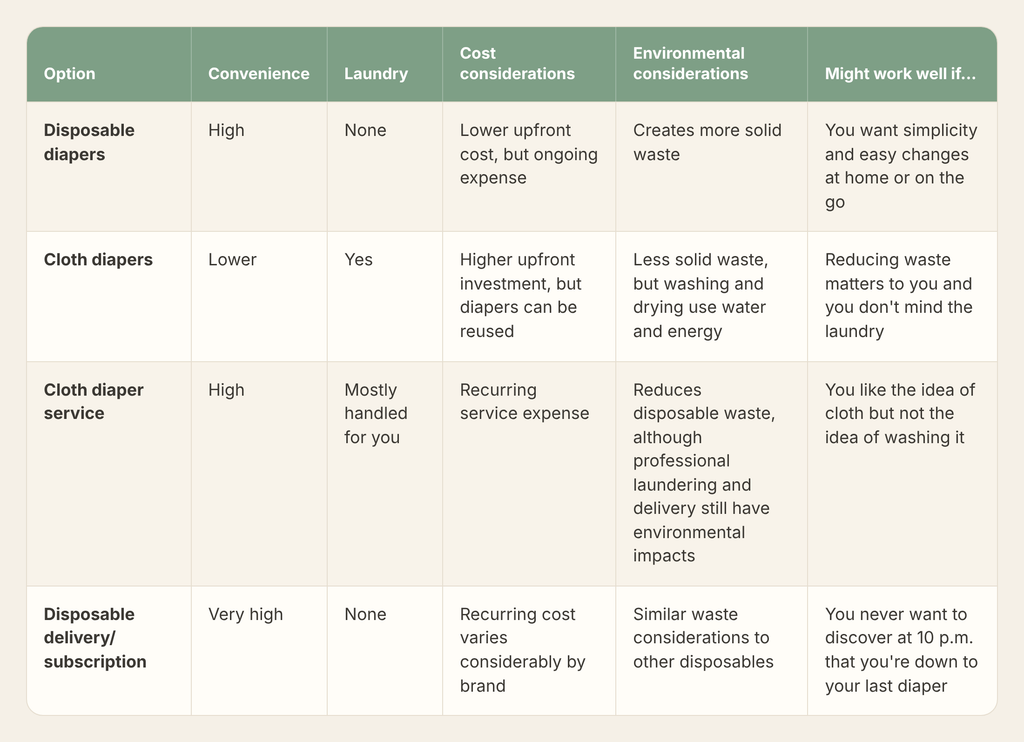
Costs, convenience and environmental impacts vary considerably depending on the diapers, service, location and how reusable diapers are washed and dried.
Option 1: Disposable diapers
Disposable diapers are probably the simplest option. Use them, toss them, replace them.
They’re also highly absorbent. Keeping the diaper area dry and changing wet or soiled diapers frequently is important for preventing diaper rash, and today’s disposable diapers are designed to draw moisture away from the skin.
The obvious downside is waste. A baby goes through a lot of diapers, especially during the newborn months, and all of those diapers have to go somewhere.
Cost can also add up. There are inexpensive store brands, major national brands and premium diapers that can cost considerably more, so “disposable” isn’t really one price category.
Consider disposables if: convenience, absorbency, travel, daycare and minimizing laundry are high on your list.
Option 2: Cloth diapers
First, modern cloth diapers aren’t necessarily the giant pieces of cloth, pins and rubber pants you might picture from your parents’ generation.
There are several different systems now, including inserts with waterproof covers, pocket diapers and all-in-one diapers that look and function much more like disposables.
The major advantage is reuse. Instead of throwing away thousands of diapers, you wash them and use them again. If they’re kept in good condition, they may also be reused for another child.
But someone has to wash them.
And that’s the part I couldn’t get past.
If laundry doesn’t bother you, your experience may be completely different. But it’s worth being realistic about how much time you want to spend rinsing, washing, drying and managing diapers when you’re already caring for a baby.
Consider cloth if: reducing disposable waste is important to you, you’re comfortable with the laundry involved, and the upfront investment works for your budget.
Option 3: A cloth diaper service
This is the option I probably didn’t fully understand when my daughter was a baby.
With a diaper service, you get many of the benefits of reusable cloth without necessarily having to wash piles of dirty diapers yourself.
Depending on the service, clean cloth diapers are delivered to your home and dirty ones are picked up and professionally laundered. Some services don’t even require you to rinse the diapers first.
Of course, you’re paying someone to do the work, so the convenience comes with an ongoing service cost. Availability also depends on where you live.
Consider a diaper service if: you want to use cloth but the laundry is what’s stopping you.
Option 4: Disposable diaper delivery or subscription
This is essentially the route we took.
Instead of remembering to buy diapers every week, you have a supply delivered on a regular schedule. Some diaper brands offer subscriptions directly, while retailers also offer recurring delivery.
The biggest benefit is pretty obvious: convenience.
But subscription diapers aren’t automatically cheaper, more sustainable or better for your baby’s skin. Those things depend on the actual diaper you’re buying. Delivery is simply another way of getting them.
And that’s an important distinction.
Don’t forget your baby’s skin
If your baby has eczema, sensitive skin, or recurring diaper rash, this may become one of the biggest factors in your decision.
Keeping the diaper area clean and dry and changing diapers frequently is important regardless of which kind you choose. Highly absorbent disposable diapers can help draw moisture away from the skin, while cloth diapers may require more frequent changes because they’re generally less absorbent.
That doesn’t mean a baby with sensitive skin can’t wear cloth. It means you may need to pay closer attention to absorbency, laundering products, how frequently you’re changing your baby, and how your baby’s individual skin reacts.
And babies, inconveniently, don’t always read the product reviews.
What works beautifully for your friend’s baby may not work for yours.
What about the environment?
This was one of my biggest considerations, and it’s probably one of the easiest areas to oversimplify.
Disposable diapers generate considerably more solid waste. Cloth diapers can be reused over and over, but laundering requires water and energy. Machine drying adds more energy use. Manufacturing also has an environmental footprint regardless of which type of diaper you choose.
Research comparing the full lifecycle of reusable and disposable diapers generally finds environmental advantages to reusable diapers in many circumstances, but the results depend significantly on how they’re manufactured, washed, dried and reused.
So if environmental impact is your biggest concern, don’t just ask:
Cloth or disposable?
Also ask:
- Will I wash full loads?
- Can I air-dry some or all of them?
- Will I use energy-efficient washing?
- Could I reuse the diapers for another child or pass them along?
- If I’m using disposables, are there materials, packaging or disposal considerations that matter to me?
The answer is more nuanced than I realized when I first started researching diapers 14 years ago.
You can also mix and match
This is probably the option that doesn’t get talked about enough.
You don’t have to join Team Cloth or Team Disposable.
You could use cloth at home and disposables when traveling. You might use disposables at daycare and cloth at home. You could use a cloth diaper service during the exhausting newborn stage and eventually wash your own. Or you might start with one system and realize three months later that it simply isn’t working for your family.
Change it.
There are enough things to feel guilty about as a parent. Your diaper system doesn’t need to become one of them.
And then there are the parents with five kids
Not long ago, I was talking with another mom at one of my daughter’s softball tournaments. She has five kids, and somehow we got onto the subject of diapers. I can’t remember exactly what we were talking about—maybe how expensive everything has gotten—but she laughed and said something along the lines of, “After five kids, all diapers are the same to me.”
Ha.
And maybe there’s something to that.
When you’re preparing for your first baby, every decision can feel incredibly important. What’s safest? What’s healthiest? What’s best for the environment? What should I be buying? I know I thought about all of those things.
Then you talk to a mom who’s diapered five kids.
So yes, research your options. Think about what matters to you. Try to make a choice that works for your baby, your budget, and your life.
But maybe don’t stress too much about finding the perfect diaper.
According to at least one very experienced mom, you might feel very differently about all of this by kid number five.
So, which diaper setup sounds like you?
If your top priority is convenience:
Start by looking at disposable diapers or a disposable delivery/subscription service.
If reducing solid waste is most important:
Explore reusable cloth diapers and look closely at how you’ll wash and dry them.
If you want cloth without all the laundry:
See whether there’s a cloth diaper service available in your area.
If your baby has particularly sensitive skin:
Pay close attention to absorbency, ingredients/materials, laundering products, and how your baby’s skin responds rather than assuming one diaper type will work for every baby.
If you’re still not sure:
Try more than one.
You don’t have to figure out your baby’s entire diapering career before they come home from the hospital.
Looking back, I chose what worked for us then: disposable diapers free of harsh chemicals delivered to our door. Someone else may look at the same factors I did and choose cloth. Another family might happily pay for a diaper service so they can have reusable diapers without doing the laundry.
That’s really the point.
The best diaper setup isn’t necessarily the one that’s theoretically the cheapest, greenest or most convenient.
It’s the one that works for your baby and your family.
Sources & further reading
If you want to dig a little deeper into cloth versus disposable diapers, diaper rash, and the environmental trade-offs, these are some helpful resources:
- American Academy of Pediatrics / HealthyChildren.org — “Diapers: Disposable or Cloth?”
A practical overview of cloth and disposable diapers, including absorbency, changing frequency and environmental considerations. - American Academy of Pediatrics / HealthyChildren.org — “Common Diaper Rashes & Treatments”
Guidance on keeping the diaper area dry, choosing absorbent diapers and caring for irritated skin. - American Academy of Pediatrics / HealthyChildren.org — “Why Is My Baby Always Getting Diaper Rashes?”
Information about sensitive skin, diaper and wipe ingredients, fit and laundering cloth diapers. - United Nations Environment Programme — Life Cycle Review of Single-Use Nappies and Their Alternatives
A review of lifecycle studies comparing disposable and reusable diapers, including the effects of washing practices, energy use and reuse. - UK Environment Agency — Lifecycle Assessments of Disposable and Reusable Nappies
Research that considers raw materials, manufacturing, water and energy use, laundering and disposal when comparing diaper systems.
A quick note
Diaper technology, products and services continue to change, and every baby’s skin is different. If your baby develops a persistent or severe rash, talk with your pediatrician rather than relying solely on a change in diaper type.
We’d love to hear from you!
What stood out to you from this post? Your stories, questions, and ideas help make this community stronger.